

SMART HOMES. SMARTER LIVING. HOW TECHNOLOGY COULD SHAPE HORIZONT HOMES
Updated: Sep 21
Technology is changing what people expect from their homes. Heating, lighting, security, energy generation and electric vehicles are increasingly becoming part of one connected residential ecosystem.
For HORIZONT, the ambition is not to fill a home with technology simply because it is available. The objective is to explore how carefully selected smart systems could make future homes easier to operate, more energy-aware, more adaptable and more comfortable to live in.
As the HORIZONT concept develops, technology is intended to support the architecture rather than dominate it.
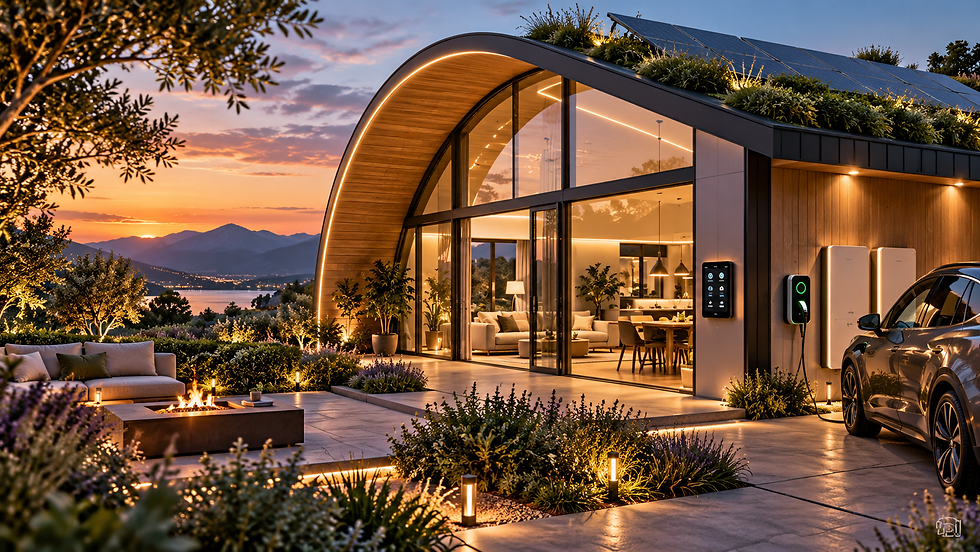
What Does Smart Home Technology Actually Mean?
A smart home can connect selected building systems and devices so that they can be monitored, controlled or automated.
That might include heating, lighting, security, ventilation, energy monitoring and EV charging. Over time, renewable generation and domestic battery storage could also become part of the same connected energy system.
But the most useful technology is often the technology occupants barely notice.
A successful smart-home strategy should simplify everyday living rather than introduce unnecessary complexity.
Comfort that responds to the home
Heating controls are one of the clearest potential applications.
Future HORIZONT homes could use intelligent controls to help occupants manage temperatures, heating schedules and individual zones more efficiently. When combined with a high-performance building envelope, appropriate ventilation and an efficient heating system such as an air-source heat pump, these controls could help balance comfort with energy demand.
The objective is not automation for its own sake.
It is a home that responds intelligently to how it is being used.
Lighting designed around everyday life
Smart lighting could allow residents to create different settings for different parts of the day while reducing unnecessary energy use.
Lighting schedules, occupancy sensing and remote control could all form part of a future specification.
Within HORIZONT architecture, however, artificial lighting should work alongside something even more fundamental: natural daylight.
Large areas of glazing and carefully considered orientation are intended to make daylight part of the architectural experience, with smart lighting complementing rather than replacing it.
Understanding household energy
One of the most important opportunities for connected homes is energy visibility.
Future HORIZONT homes could allow occupants to monitor how energy is being used and, where appropriate, generated.
A connected energy strategy could ultimately bring together:
Heating controls
Household energy monitoring
Solar PV generation
EV charging
Future battery storage
Selected smart appliances
Instead of each technology operating completely independently, the longer-term objective would be to consider how they could work together as one residential energy ecosystem.
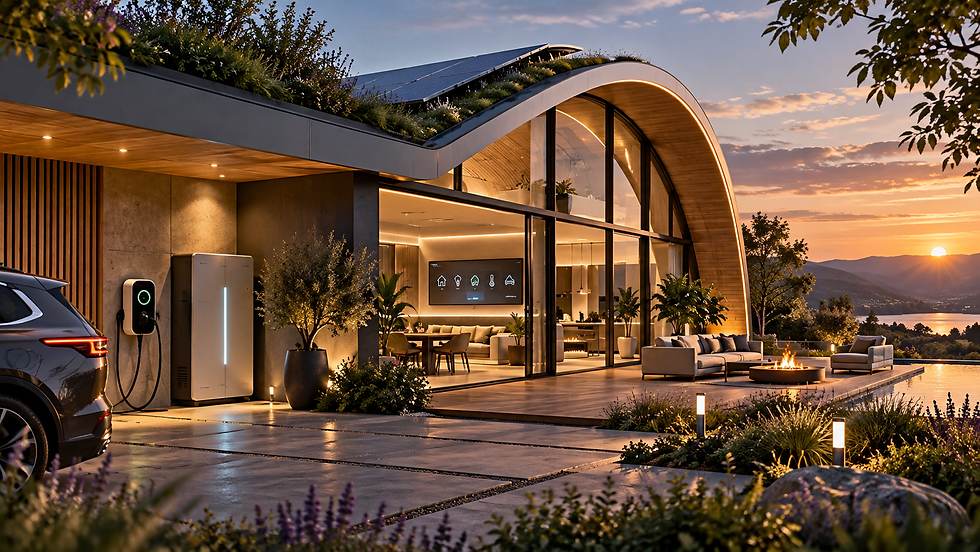
Solar, EVs and the connected home
The relationship between a home and energy is changing.
A future home may not simply consume electricity. It may generate electricity through solar PV, charge an electric vehicle and potentially store energy within a domestic battery.
For HORIZONT, this is why smart-home thinking needs to extend beyond voice-controlled lights or connected appliances.
The infrastructure itself should be considered.
Designing for EV charging, renewable generation, energy monitoring and future storage from an early stage could make homes easier to adapt as technology develops.
Security without turning the home into a gadget
Connected security can also form part of smart residential design.
Depending on the final specification, future systems could include smart access, video doorbells, selected cameras, alarms or remote notifications.
But greater connectivity also creates responsibilities around cybersecurity and privacy.
Any future HORIZONT smart-home strategy would therefore need to consider not only what a system can do, but how securely and responsibly it handles information.
A home that can evolve
Perhaps the most important technology feature is one that is less visible: upgradeability.
Technology changes far more quickly than buildings.
A home intended to last for generations should not become obsolete simply because a particular smart-home platform or device changes.
That is why future upgradeability forms part of the thinking behind the HORIZONT Standard.
Where practical, building systems, controls and infrastructure should be considered with future replacement and technological development in mind.
The aim should be to create an adaptable home — not a permanently fixed snapshot of today’s technology.
Technology should remain optional, intuitive and useful
Not every homeowner wants the same degree of automation.
One resident may want extensive connected controls. Another may simply want efficient heating, straightforward energy monitoring and reliable EV charging.
That flexibility matters.
The HORIZONT approach should therefore prioritise systems that remain understandable and usable without forcing residents into unnecessarily complicated technology.
Smart living should ultimately mean better living, not more screens, applications and subscriptions.
Where could the technology go next?
Artificial intelligence, improved energy management, domestic batteries and increasingly connected energy networks could change residential technology considerably over the coming years.
Homes may become better at understanding patterns of energy use, coordinating renewable generation and responding to changing tariffs or household requirements.
Exactly which technologies become part of future HORIZONT homes will depend on final specifications, technical development, market availability and individual projects.
But the underlying principle is already clear:
the home should be capable of evolving with the people who live in it.
A smarter approach to future living
For HORIZONT, smart technology is intended to be only one part of a much broader residential philosophy.
Architecture, energy efficiency, renewable technology, comfort, durability and intelligent controls should work together rather than being treated as separate features.
The goal is not to create a house filled with gadgets.
It is to explore a home that is easier to manage, more aware of its energy use, prepared for future technology and designed around everyday life.
HORIZONT is currently at concept and development stage. Technologies and systems discussed in this article represent potential future specifications and design objectives and are subject to detailed design, engineering, product selection, testing and project requirements.
How could smart technology support lower-energy, more adaptable HORIZONT homes? We explore connected heating, energy monitoring, EV charging, solar integration and the future of intelligent residential living.
Comments